Reliable diagnostic assessments, hydronic troubleshooting, and cast-iron steam restoration for homes, multi-family properties, and retail facilities throughout Ozone Park, Queens. When winter temperatures drop along Liberty Avenue and Cross Bay Boulevard, our mechanical specialists pinpoint boiler faults and restore balanced heating safely.
The residential housing stock of Ozone Park features a rich architectural mix, ranging from detached and semi-detached single-family frame homes built during the early twentieth century to solid brick two-family flats and multi-family brownstones. In these varied properties, dependable heating is a vital necessity. Whether your basement houses a legacy single-pipe gravity steam boiler or a modern multi-zone forced hot water system, equipment requires meticulous maintenance to survive harsh New York winters.
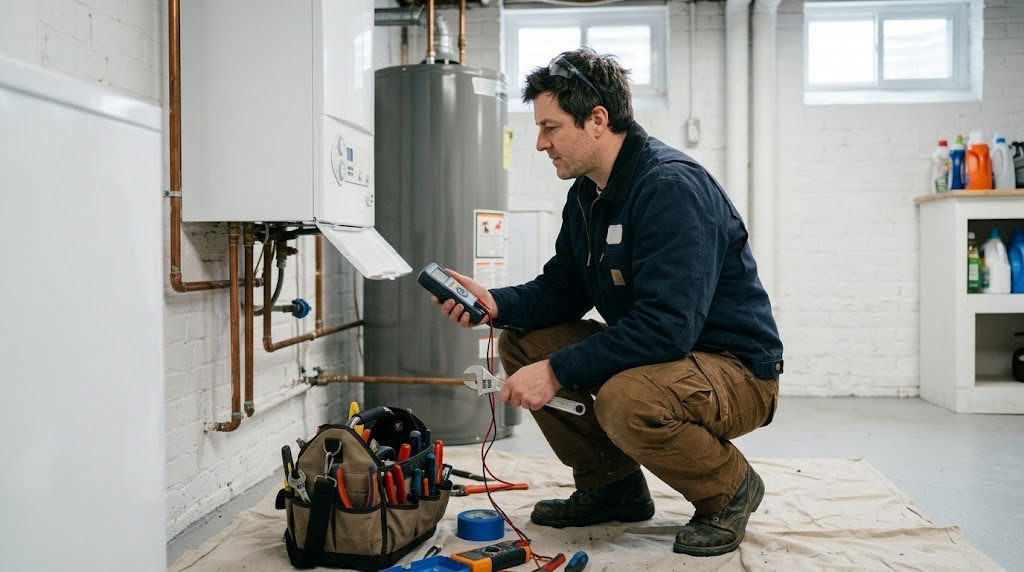
When a homeowner faces a boiler not working Ozone Park Queens emergency during a freezing cold snap, quick action is essential to prevent frozen pipe bursts and severe interior water damage. Our technicians arrive with specialized diagnostic combustion meters, digital aquastat testing tools, and pressure calibrators to systematically inspect burner manifolds, electrical relays, low-water cutoff floats, and relief valve assemblies.
If your property suffers from a sudden no heat boiler repair Ozone Park Queens situation, we evaluate the complete heating circuit—from the gas supply pressure entering your meter to the return line temperature returning to the boiler block. For broader system upgrades, review our engineering options for boiler replacement in Ozone Park or discover our specialized steam heat & radiator repair services.
Speak directly with an experienced plumbing professional. Describe your boiler make, pressure gauge readings, and symptoms for prompt diagnostic guidance without automated answering delays.
Heating systems rarely fail without warning. Recognizing early operational anomalies allows homeowners to schedule repairs before complete mechanical shutdowns occur in freezing weather.
Puddles around your boiler indicate leaking pipe joints, a weeping temperature-pressure relief valve, corroded circulator pump flanges, or cracked cast-iron heat exchanger sections requiring urgent mechanical inspection.
When a burner fires up, runs for a brief two minutes, and abruptly shuts down, the system is short-cycling. This stresses internal ignition modules and is typically caused by malfunctioning aquastats, low water cutoff trips, or poor water circulation.
Violent knocking sounds in boiler pipes—frequently termed kettle-effect or water hammer—arise from mineral scale pockets creating trapped steam bubbles, improper pipe pitch, or failing air elimination vents.
Hydronic boilers require steady pressure (typically 12 to 15 PSI cold). If the pressure gauge repeatedly drops toward zero, an undiscovered leak exists in underground distribution pipes, baseboards, or the automatic water feeder valve.
Natural gas boiler flames must burn a crisp, steady blue. Yellow, flickering, or rolling flames indicate incomplete gas combustion, blocked flue heat exchangers, or restricted intake air that produces dangerous carbon monoxide.
If your boiler displays an error code on its digital diagnostic display or refuses to ignite regardless of thermostat calls, internal safety lockouts have triggered to prevent hazardous operating conditions.
Understanding your building's mechanical heating design is fundamental to diagnosing problems accurately. Ozone Park contains an even split between historic steam heating and modern hydronic baseboards.
In steam systems, water is boiled inside the vessel until steam naturally expands under low pressure (0.5 to 2.0 PSI) up through main distribution risers to cast-iron radiators. As the steam gives off heat, it condenses back into water and flows back through single-pipe or two-pipe gravity returns.
Our steam boiler repair Ozone Park Queens services address common vulnerabilities including water level sight glass leaks, seized mechanical blowdown valves, defective McDonnell & Miller low water cutoffs, and pressuretrol gauge calibration.
Hydronic heating circulates closed-loop water maintained under pressure (12 to 20 PSI) through baseboard convectors, panel radiators, or radiant tubing utilizing electric circulator pumps. The water is heated to roughly 160°F–180°F without boiling into steam.
Our hot water boiler repair Ozone Park Queens calls frequently involve waterlogged diaphragm expansion tanks, seized multi-zone circulator cartridges, faulty automatic air scoops, and stuck zone valve motor actuators.
When executing gas boiler repair Ozone Park Queens, our certified technicians perform thorough electrical and hydronic testing on all mission-critical safety and operational controls:
For homeowners in neighboring districts seeking reliable heating help, our technicians also provide prompt boiler repair near Woodhaven and surrounding Queens neighborhoods including boiler repair near South Ozone Park.
Do not let a small burner anomaly turn into an overnight no-heat crisis. Connect with an experienced Queens heating specialist right away.
We follow a rigorous, methodical diagnostic sequence to pinpoint underlying mechanical defects rather than temporarily patching superficial symptoms.
We evaluate equipment nameplate data, historical symptoms, sight glass water levels, system pressure gauges, and check the surrounding cellar slab for active leaks.
Technicians meter 120V line supply and 24V control loops, verifying thermostat sequencing, aquastat settings, spark electrodes, and flame rectification microamps.
We examine flue draft conditions, inspect the heat exchanger for soot accumulation or pinhole stress cracks, and evaluate circulator pumps and expansion tank bladders.
Defective components are replaced with manufacturer-specified OEM parts. The burner is test-fired through full heating cycles to confirm stable combustion and relief valve integrity.
When a boiler acts up, homeowners frequently wonder whether investing in a repair makes practical economic sense or if complete replacement is the wiser route. At NY Plumbing, we believe in providing honest, practical technical evaluations so property owners can make informed investments.
When Repair Makes Sense: If your cast-iron boiler is under 15 to 18 years old, the heat exchanger block is structurally sound, and the issue is isolated to an external serviceable component—such as a thermocouple, electronic ignition module, circulator pump, or pressure relief valve—targeted repair is typically fast, reliable, and cost-effective.
When Replacement Is Recommended: Cast-iron boilers have an operational lifespan of 20 to 30 years. If the cast-iron sections have cracked, internal scale has permanently restricted water pathways, or the unit has suffered repeated catastrophic low-water dry fires, replacement is necessary. Modern condensing boilers and modern atmospheric cast-iron units offer significantly higher annual fuel utilization efficiency (AFUE), lowering winter utility bills.
Explore our comprehensive guide to boiler replacement in Ozone Park for sizing standards, chimney liner requirements, and permitting details.
Boiler performance is intimately linked with your property's broader mechanical infrastructure. Discover our full suite of local services across Ozone Park.
Engineered boiler sizing and turnkey installation for modern cast-iron and high-efficiency condensing heating units across Queens.
Eliminate loud banging pipes, leaking air vents, cold radiators, and resolve steam distribution imbalances throughout your residence.
Diagnostic restoration for gas, electric, and boiler-connected indirect domestic hot water tanks experiencing leaks or pilot failure.
High-definition optical camera sewer inspections, root clearing, and structural spot repairs on aging underground sewer laterals.
Heavy-duty primary sump pumps, battery backup installations, and backwater check valves protecting basements against groundwater flooding.
Licensed gas pipe leak tracing, pressure drop tests, appliance hookups, and NYC Local Law 152 building inspection support.
Mechanical snaking and hydro-jetting to clear stubborn hair, grease, and scale blockages from kitchen, tub, and basement floor drains.
Professional repair and installation for leaking bathroom faucets, running toilets, faulty flush valves, and kitchen sink fixtures.
Our service vans are organized around the major transportation corridors of Southern Queens—ensuring rapid dispatch along Liberty Avenue, Cross Bay Boulevard, and Rockaway Boulevard.
Our central operational focus. From older frame colonials near 101st Avenue to multi-family brick flats, we deliver complete boiler, steam, and mechanical plumbing coverage.
Directly north across Atlantic Avenue, Woodhaven features pre-war homes with robust cast-iron steam heating and complex two-pipe gravity radiator circuits.
Extending south toward the Belt Parkway, properties here frequently combine hydronic baseboard loops with basement domestic hot water and sump drainage needs.
Review helpful technical explanations addressing recurring boiler problems encountered by Queens property owners.
In steam heating systems common throughout Ozone Park, cold radiators frequently stem from clogged air vents that trap cool air and prevent steam ingress, defective steam traps, or an improperly calibrated pressuretrol keeping operating pressure too low. In hydronic hot-water systems, airbound radiation loops, failed zone valves, or a seized circulator pump prevent heated water from circulating through baseboard convectors.
Modern and retrofitted boilers use electronic flame sensors, intermittent spark ignition modules, and safety interlocks that trigger lockout if flame presence is not detected within milliseconds. Common causes include carbon-fouled flame rectification rods, restricted chimney draft hoods triggering spill switches, low water cutoff trips from insufficient water levels, or gas supply pressure fluctuations.
While NYC municipal water is generally low in mineral hardness compared to well water, steam boilers that receive frequent fresh makeup water accumulate mineral scale and sludge in the mud legs and wet return pipes. This scale acts as a thermal insulator, causing cast-iron heat exchanger sections to overheat, crack, or suffer thermal shock.
If a cast-iron boiler is over 20 to 25 years old and develops a cracked section, severe heat exchanger corrosion, or recurring electronic control failures requiring obsolete parts, investing in an engineered high-efficiency boiler replacement is significantly more cost-effective than recurring emergency service calls.
Speak directly with a skilled mechanical technician to troubleshoot your heating system today.