Certified natural gas pipe repair, high-pressure decay testing, and NYC Local Law 152 periodic inspections across Ozone Park, Queens. When gas piping develops corrosion, fails utility meter tests, or requires code-compliant extensions for new heating equipment, our licensed technicians deliver uncompromising safety and compliance.
Natural gas is the primary heating and cooking fuel powering homes across Ozone Park. However, natural gas requires rigorous mechanical oversight. Over decades of damp basement conditions, schedule 40 black iron gas piping can suffer from external oxidation, rusted union joints, and loose threading that allow combustible methane to seep into enclosed cellar environments.
When searching for reliable gas line repair Ozone Park Queens, working with a properly licensed and insured plumbing contractor is not just a preference—it is a strict municipal requirement under the NYC Department of Buildings (DOB). We provide comprehensive gas piping inspection Ozone Park Queens, utilizing advanced combustible gas sniffers and calibrated pressure gauges to certify pipeline integrity.
From installing modern schedule 40 runs for boilers to executing a dedicated gas line installation for stove Ozone Park Queens, our team manages the entire process—including utility coordination with National Grid. To learn more about modern high-efficiency heating conversions, consult our boiler replacement in Ozone Park guide or review our water heater repair services.
Need a certified pressure test, appliance hookup, or Local Law 152 building inspection? Speak directly with our licensed plumbing team.
Under NYC Local Law 152 (LL152), all commercial buildings and multi-family residential structures containing more than two dwelling units are legally mandated to have their exposed gas piping inspected once every four years by a Licensed Master Plumber. (Note: One- and two-family residential buildings classified as R-3 are generally exempt from periodic LL152 filings).
Our certified inspectors conduct thorough evaluations across all public spaces, basements, hallways, and boiler mechanical rooms:
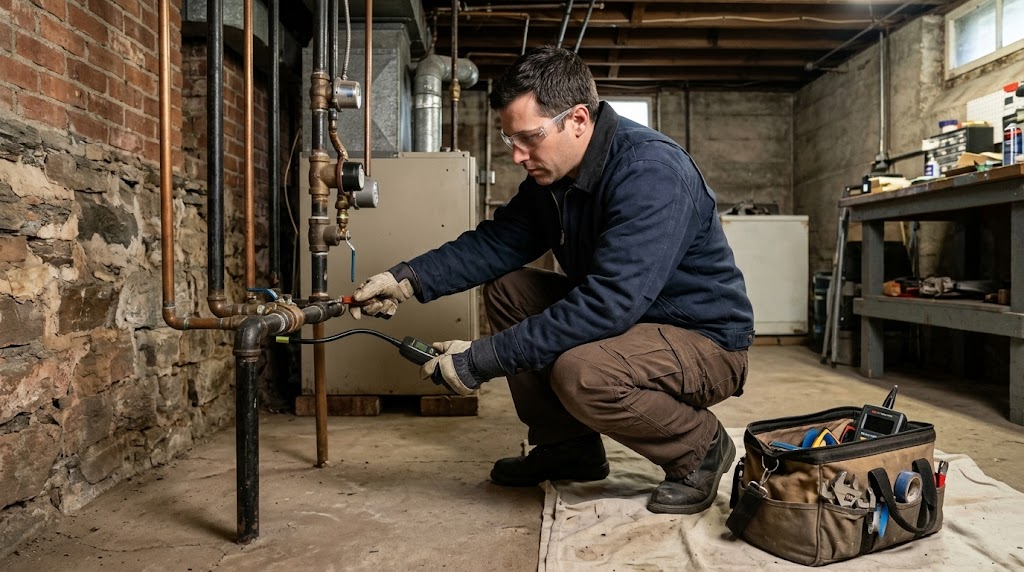
Professional diagnostic testing and repair for dangerous gas piping vulnerabilities in Queens.
Basement moisture oxidizes black iron pipe threads and ground-joint unions, degrading the pipe dope seal and creating microscopic gas seepage points.
If National Grid locks your gas meter due to a pressure drop, our licensed team locates the leak, repairs the piping to current code, conducts a witnessed pressure test, and files DOB paperwork for restoration.
Handyman installations often utilize unapproved brass fittings, excessively long corrugated hoses, or lack required emergency shutoff ball valves and sediment traps, creating major fire hazards.
Critical knowledge on safety protocols, code regulations, and pressure testing in New York City.
If you smell the distinctive rotten-egg odor of natural gas (mercaptan), evacuate all occupants from the building immediately. Do NOT turn electric light switches on or off, do not use house phones or cell phones inside, do not unplug appliances, and do not light matches. Once safely outdoors and away from the structure, immediately dial 911 or the National Grid gas emergency hotline.
Under NYC Local Law 152, all commercial properties and multi-family residential buildings containing more than two dwelling units (excluding single-family and two-family R-3 residential properties) must undergo a certified gas piping inspection every four years by a licensed master plumber. The inspection surveys all exposed gas lines from the point of entry to public spaces, hallways, and boiler rooms for corrosion, illegal connections, and gas leaks.
After isolating gas appliances and capping downstream branches, the piping system is pressurized with inert nitrogen or air to a test pressure exceeding normal operating levels (typically 3 to 15 PSI depending on pipe size and NYC DOB requirements) using a calibrated digital manometer. The gauge is monitored over a specified duration; any measurable pressure decay confirms a hidden leak that must be pinpointed with ultrasonic acoustic meters and certified bubble solution.
No. Under the NYC Fuel Gas Code, all gas piping modifications, extensions, and appliance connections must strictly be executed by or under the direct supervision of a Licensed Master Plumber (LMP) who files the necessary work permits with the NYC Department of Buildings. Unlicensed gas work is strictly illegal, extremely hazardous, and invalidates property insurance policies.
Call (315) 202-8009 to speak with our licensed fuel gas team for testing, repairs, and code filings.